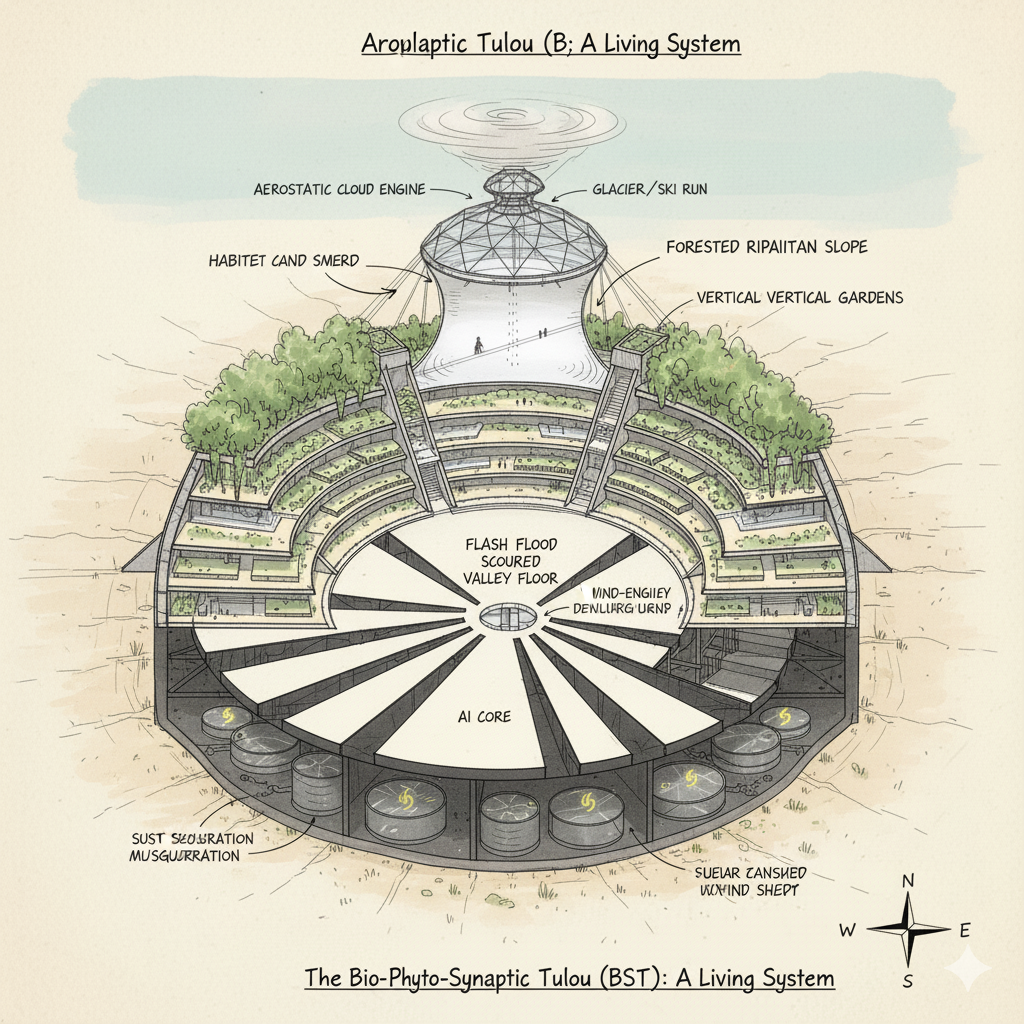
🌳 The Bio-Synaptic Tulou (BST): Comprehensive Brief
The Bio-Synaptic Tulou (BST) is an extremeophile, regenerative habitation and operations center designed for indefinite hermetic autonomy and positive ecological surplus in an Arid/Coastal Wadi environment. Modeled as an Architectural Mountain and inspired by the resilience of Bryophytes, the BST functions as a self-aware, multi-cellular organism, balancing internal life-support with external resource generation.
1. 🏗️ Architectural Form and Structural Resilience
The BST employs a monumental, multi-story, stepped circular form (a Tulou, Pyramid analogue) with a central dome/cupola.
Materials & Shielding: The structure is built using high-thermal-mass materials (thick, reinforced concrete, and dense rammed earth) for stability against seismic events, extreme heat, and sandstorms. All critical systems are hardened against EMP and CBRN threats.
Layering (Top-Down): The decks establish distinct ecological and functional zones:
D9 & D8 (Upper Mountain): Narrowest decks, hosting the Aerostatic Cloud Engine (cupola) and the Forested Riparian Slope analogue (trees, lake analogue, biodiversity).
D7 (Plateau): The Water Cycle Plateau, dedicated to advanced water filtration, polishing, and aquaponics overflow.
D4, 5, 6 (Mid-Levels): The primary Vertical Canyon City habitat. These decks form a near-vertical, slightly recessed wall for high-density vertical farming.
D3 (Floor): The Flash Flood Scoured Valley Floor, the central ceremonial plaza designed as the primary internal water drain.
D0, 1, 2 (Subterranean): The secure Core Caves, housing manufacturing, AI core, utilities, and waste processing.
2. 🌲 The Phyto-Synaptic Core (Interior Life Support & Habitat)
The interior is a closed-loop biosphere, prioritizing human comfort and sustained ecological production.
Habitat ({D4-D6}): Dwelling units, labs, and social areas are embedded in the walls of the Vertical Canyon City, benefiting from the stable, warm, humid, O2-rich atmosphere of the vertical farms.
Thermal Balance (The Thermo-Synaptic Loop): The system balances two extremes:
Heat Sink: The Geothermal Hotsprings (D0/1) collect high-grade waste heat (servers, generators) for passive use and to power an Absorption Chiller.
Cold Sink: The Chiller uses this waste heat to produce chilled fluid, maintaining the sub-zero Glacier (D9, N-Aspect), which acts as a massive ice thermal storage battery and recreational amenity.
Atmospheric Engine: The Aerostatic Cloud Engine (D9 cupola) takes the warm, moist "breath" of the habitat, nucleates moisture, and recovers water, driving the internal rain cycle and supplementing the Glacier's cold load.
3. 🌵 The Rhino-Biotic Shell (Exterior Regeneration & Defense)
The exterior manages the harsh desert environment, converting stress into regenerative resources.
Water Sourcing (D7-D9 Exterior): The upper decks form the Hanging Oasis / Bio-Filter Layer, maximizing fog/dew collection from coastal air. Water flows through this layer for initial pre-filtration before entering the internal systems.
Aerodynamic Shield (S-Aspect): The curved, stepped south façade acts as a Wind Engine, creating a solar chimney updraft for passive cooling of the building envelope.
Resource Capture: The Wind Engine geometry includes specialized sequestration zones that trap fine dust/particulate matter. This dust is flushed with surplus water to create a mineral-rich slurry.
Regenerative Export (D0/D1 Plinth): The Ecological Restoration Plinth is the export point. It receives the surplus, treated digestate (nutrients) and the dust slurry, anchoring local soil stabilization and Wadi restoration efforts with a continuous source of water and substrate.
4. 🧠 Autonomous Control (The Synaptic Network)
The AI Core (D0-D2) acts as the BST's nervous system, operating through Adaptive Homeostasis.
Sensory Network: A dense array of internal (O2, pH, nutrients) and external (PM, wind, salinity) sensors provides continuous feedback on metabolic and environmental health.
Bio-Indicators: Integrated microbial/fungal mats in the filtration systems provide highly sensitive, early detection of biological or chemical threats, reflecting the sensitivity of the Bryophyte analogue.
Autonomous Response: The AI controls the Thermal Balancing Loop and precisely regulates the regenerative Nutrient/Water Export Valve to maximize positive ecological input based on the needs of both the internal farm and the external Restoration Plinth. It triggers hermetic sealing and load shedding protocols in emergency scenarios.